Friday, February 10, 2012

Science 2/10/2012

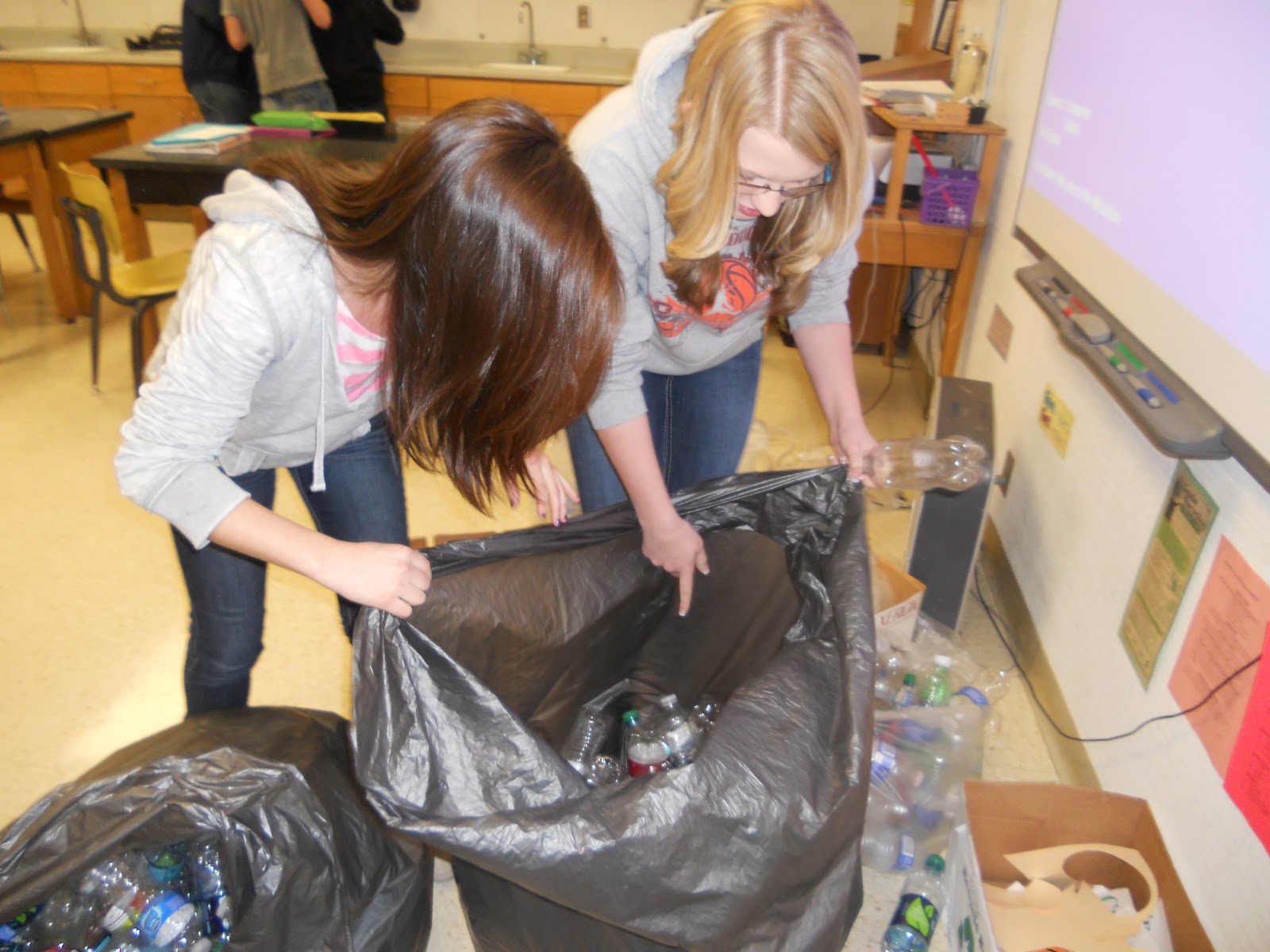
We've been studying Newton's Laws of Motion. Students are making water bottle rockets as a final project. We plan on  launching next Friday (the 17th,  as the weather is predicted to be fair that day.) I'll post more pictures after the launch.


Supplies


Creating a fin pattern

Bottle, bottle, which bottle should I use?

Laying out a nosecone.

Ensuring a tight fit for proper pressurization.
Hot glue assembly.


Can you believe this is going to be a parachute?

Student garantees it will be "the best!"

Tuesday, January 31, 2012

Jan. 31, 2012

Finally feel like I am back into the swing of things. 

Have been reviewing Newton's Laws. Test on Friday, Feb. 3. We will begin to build Water Bottle Rockets on Monday, Feb. 6, for hands on demonstrations of those laws. Several of the websites that we will use are listed on my Portaportal under Physics - Rockets. - http://guest.portaportal.com/mrs.poulseen

The students are also reading a science fiction book of their choice. They will complete a book report "booklet" which is due on March 2 (but can be handed in ahead of time if they choose to.) Here's a link on how to fold the booklets - http://www.youtube.com/watch?v=IAb31rIeGZo

Wednesday, December 21, 2011

Science 12/21/2011

We are completing the presentations of the State Technology Assessment. Lots of learning about biodiversity, biotechnology, and natural disasters. The products and presentations are better than they have been in the past - way to go 8th graders!


We had been observing a banana over the course of a month to see how it changes (physical and chemical.) I'm adding a pic that compares the banana when we began and when we ended.


Here's hoping that everyone has a good time and safe travel during the break.  

Monday, December 12, 2011

Science 12/12/2011

1st week of the Technology has passed. Students should have completed all of their research for their topic at this point.

Here is what is planned for this week -
Monday - How to create a good presentation and time to start a Google Presentation
Tuesday - Work on  Google Presentation
Wednesday - Demonstrate how to insert a link and working on Google Presentation
Thursday - Demonstrate BibMe for citations and work on Google Presentation
Friday - Demonstrate how to use speaker notes, good presentation skills and work on Google Presentation

Next week - Present their research and Google Presentation
Presentation order will be drawn randomly

Monday, December 5, 2011

Science 12/5/2011

8th Graders started the State Technology Assessment today.

They will be researching a topic from the book "High Noon, 20 Global Problems and 20 Years to Solve Them" by Jean-francois Rischard.

They will be researching a topic/problem this week.

Next week they will determine their solution and create a presentation about it.

Then the week before Christmas they will be sharing the presentation with their fellow students and select faculty.

So be sure to ask an 8th Grader about it.

Click here to see the prensetation Mrs. Bartlett shared with them. To see the speaker notes, comments on the slides,  click on the "face" to the lower right of the screen.

Thursday, December 1, 2011

Science 12/01/2011


Study guide for Chemistry Content Test Key:
What is the definition of matter?
            Mass and volume
What are some properties of matter?
            Density, color, shape, odor, texture, ductility, reactivity
What is the definition of a liquid?
            No definite shape, definite volume
What is the definition of a gas?
            No definite shape, no definite volume
What is the definition of a solid?
            Definite shape, definite volume
What is the definition of plasma?
            No definite shape, no definite volume, particle broken apart
What are the indicators of a chemical change?
            Color change, bubbles or gas, heat or light, precipitants
What is the difference between a physical change and a chemical change?
Physical changes can often be undone, chemical can not be undone and are accompanied by a physical change
Give an example of a solution.
            Salt water
Give an example of a colloid.
            Jell-O, pearls, mayonnaise
Give an example of a suspension.
             Pond water
Give an example of an element.
            C, H, O, Mg, Hg, Uun
Give an example of a compound or molecule.
            NaCl, CO2
What part of an atom has a positive charge?
            Proton
What part of an atom has a negative charge?
            Electron
What part of an atom is neutral?
            Neutron
What is in the nucleus?
            Protons and neutrons
The valance shell?
            Electrons
How many protons in magnesium?
            12
How many neutrons in magnesium?
            12
How many electrons in magnesium?
            12
Which element has 21 protons?
            Scandium
What is the atomic number of H-3?
            1
What is the atomic mass or mass number of H-3?
            3
How many neutrons in a H atom?
            0
A H-2 atoms?
            1
A H-3 atom?
            2
What is a neutral or stable atoms?
            When the number of protons and electrons are equal
A positive ion?
            An atom with more protons than electrons
A negative ion?
            An atoms with more electrons than protons
How many protons in Ca?
            20

How many neutrons in Ca?
            20
How many electrons in Ca?
            20
Is H-3 an ion or an isotope?
            Isotope
How many electrons in the valance shell of Na?
            1
How many electrons in the valance shell of Cl?
            7
What is the charge of Na in NaCl?
            + or +1
What is the charge of Cl in NaCl?
            - or -1
Which is an element - Na, NaCl, Na + Cl -> NaCl, or 3Na+Cl- ?
            Na
Which is a compound - Na, NaCl, Na + Cl -> NaCl, or 3Na+Cl- ?
            NaCl
Which is a chemical formula Na, NaCl, Na + Cl -> NaCl, or 3Na+Cl- ?
            3Na+Cl-
Which is a chemical equation Na, NaCl, Na + Cl -> NaCl, or 3Na+Cl- ?
            Na + Cl -> NaCl
Where are the metals on the periodic table?
            Left of the stair step line
the metalloids?
            On the stair step line
the non-metals?
            Right of the stair step line
What group or family is Mg in?
            Alkaline Earth metals
Cu?
            Transition metals

Cl?
            Halogens           
K?
            Alkali metals
Ne?
            Noble Gasses
What is a period?
            The horizontal rows
What is a group or family?
            The columns or vertical rows
How many elements in 3H2SO4?
            3
What are they?
            Hydrogen, Sulfur, Oxygen
What is the co-efficient(s) in 3H2SO4?
            3
What is the subscript(s)?
            2 and 4
How many atoms in 3H2SO4?
            21
How many for each element?
            H-6, S-3, O-12
What type of bonding is in CO2?
            Covalent
NaCl?
            Ionic
Which bonding shares electrons?
            Covalent
Transfers electrons?
            Ionic
Has them floating freely among the atoms?
            Metallic
What factors affect reaction rates?

         Temperature, concentration, catalyst, surface area (particle size)

Tuesday, November 22, 2011

Science 11/22/2011

EXAMPLES OF CHEMICAL REACTIONS


SYNTHESIS/COMPOSITION                  2H2 + O2 à 2H2O


DECOMPOSITION                           2KClO3 à 2KCl + 3O2


SINGLE REPLACEMENT                  2Al + 3NiBr3 à 2AlBr3 + 3Ni


DOUBLE REPLACEMENT                  AgNO3 + KCl à AgCl + KNO3

VOCABULARY

CHEMICAL FORMULA – a shorthand way to show a compound or molecule

CHEMICAL EQUATION – shorthand description of a chemical reaction

CHEMICAL REACTION – the process of when substances undergo changes to produce new substances

REACTANTS – what you begin with in a chemical reaction

PRODUCTS – what you end with in a chemical reaction

SYNTHESIS/COMPOSITION REACTION – when you begin with two or more simple substance and produce a complex substance

DECOMPOSITION REACTION – when you begin with a complex substance and produce two or more simple substances

SINGLE-REPLACEMENT REACTION – when a single element switches places with an element in a compound

DOUBLE-REPLACEMENT REACTION - when a two elements switch places with each other in a two compounds

IONIC BOND – bonding between a metal and a non-metal when electrons are transferred from the metal to the non-metal

COVALENT BOND – bonding between non-metals when electron pairs are shared